I am Sherlock - Detective Minigame Quest
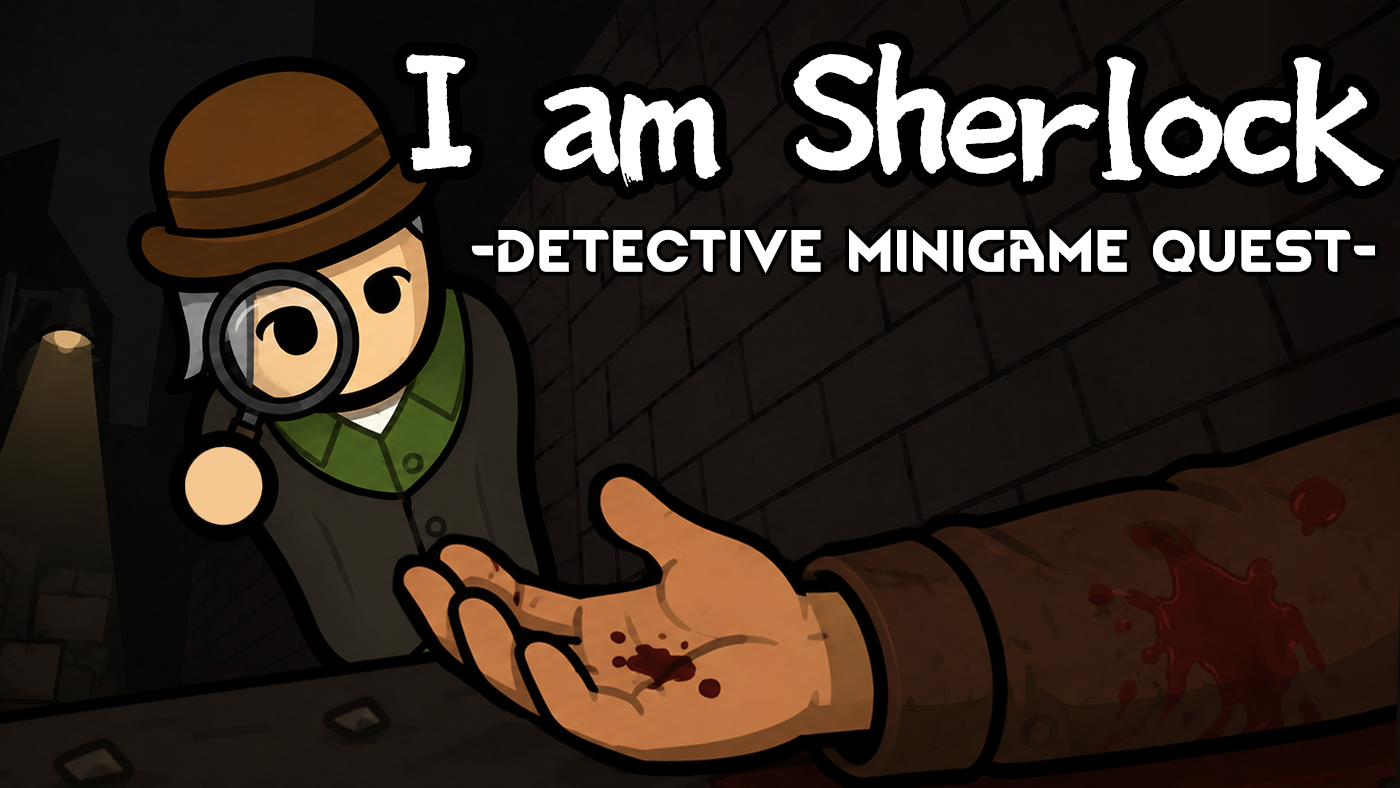
You are the RimWorld detective!
You are the RimWorld detective!
I am Sherlock - Detective Minigame Quest is an investigation-and-deduction quest mod in which you appoint one colonist as a detective and solve cases. Get sent out to crime scenes, examine the scene, and doubt what people tell you. Simply pointing a finger at the culprit is not enough. You have to refute the testimonies, submit the right evidence, and reconstruct exactly how the crime unfolded.Key Features
- Appoint one colonist as your dedicated detective
- Detective-only stats made up of Observation, Deduction, Rhetoric, and Nerve
- A variety of detective traits and assistant personalities
- Procedurally generated investigation cases that come out different every time
- Clue examination, autopsies, interrogations, and alibi checks
- A Final Deduction that requires you to refute testimony and submit evidence
- A deduction board for reconstructing the culprit's movements
Appointing a Detective
 Your settlement's dedicated detective has four investigative senses that work separately from the ordinary RimWorld skills.
- Observation: the ability to spot clues at the scene and notice when something feels off
- Deduction: the ability to connect clues to one another and eliminate the wrong options
- Rhetoric: the ability to win a suspect over or coax out the facts they are hiding
- Nerve: the ability used for hard-edged interrogation and pushing through the scene
Detective Traits
When taking office, a detective chooses one of several unique traits. Each trait carries its own strengths and weaknesses that shape how the detective investigates. Shabby attire can get the detective looked down on, while neat or imposing attire helps with Rhetoric and Nerve checks.Assistant System
Once your detective's rank rises, you can designate one colonist as an assistant. The assistant travels to the scene alongside the detective and can stand in for some of the skills needed for autopsies and examinations.- Boards the shuttle automatically together with the detective
- Once per case, consult the assistant to eliminate one wrong deduction option
- Sits in on interrogations and helps confirm belongings
- Offers lines and advice that fit their personality during the Final Deduction
Case Requests
You can look for cases directly from the casebook, or they come up naturally after some time has passed. As the detective's rank rises, higher-tier cases appear.Investigation Scene
An investigation scene is a dedicated map built for the investigation. The screen filter is applied only on the scene map, and in the mod settings you can choose the screen mood of the scene.
Time on the investigation scene only passes while the player is viewing that map.
Basic needs such as hunger and sleep for the people at the scene are frozen and time at the settlement stops too, so you can focus solely on the investigation.
The screen filter is applied only on the scene map, and in the mod settings you can choose the screen mood of the scene.
Time on the investigation scene only passes while the player is viewing that map.
Basic needs such as hunger and sleep for the people at the scene are frozen and time at the settlement stops too, so you can focus solely on the investigation.
Investigating Clues
 The scene is laid out with a variety of clues as physical objects — the murder weapon, belongings, records, traces, the body, and more.
Entering a room or approaching it reveals clues, and a right-click examination secures them and records them in the casebook.
With enough skill, you can choose a precise examination.
Examining a clue records it in the casebook.
Interrogating a suspect lets you hear their testimony and alibi.
The owner of any belongings you find is unknown at first, so you must confirm whose they are through interrogation or appraisal.
The scene is laid out with a variety of clues as physical objects — the murder weapon, belongings, records, traces, the body, and more.
Entering a room or approaching it reveals clues, and a right-click examination secures them and records them in the casebook.
With enough skill, you can choose a precise examination.
Examining a clue records it in the casebook.
Interrogating a suspect lets you hear their testimony and alibi.
The owner of any belongings you find is unknown at first, so you must confirm whose they are through interrogation or appraisal.
Case Types
I am Sherlock features six kinds of cases, each with a different way of playing out.- Murder: investigate the means of death, the motive, alibis, and testimonies to uncover the culprit.
- Theft: follow the traces in order. Solving it lets you recover the stolen goods for an extra reward.
- Disappearance: arrange the sighting records in chronological order to complete the route, then find and rescue the missing person for an extra reward.
- Sabotage: examine the distribution of fully burned, partly burned, and scorched areas across the torched scene to trace back to the point of origin.
- Infiltrator hunt: root out the disguised spy hidden among the people at the scene. Even if you let them slip away, you can examine the traces left behind after they went to ground.
- Metalhorror: find out who the metalhorror is through an infection-epidemiology investigation.
Casebook
 All investigation information is recorded in a dedicated casebook.
In the Deduction notes, you can freely write down hypotheses about the means of the crime, the motive, the trick, the hiding place, accomplices, and more.
During the investigation phase, you are not told immediately whether a hypothesis is correct, so you must compare the clues and testimonies yourself and reach a conclusion.
All investigation information is recorded in a dedicated casebook.
In the Deduction notes, you can freely write down hypotheses about the means of the crime, the motive, the trick, the hiding place, accomplices, and more.
During the investigation phase, you are not told immediately whether a hypothesis is correct, so you must compare the clues and testimonies yourself and reach a conclusion.
Archive
Solved cases are kept permanently in the archive. After solving one you can give it a name yourself or have a random title suggested, and even if the incumbent detective dies or leaves, their career and case records are inherited by the successor.Final Deduction
 Once you have secured every clue you need, you can begin the Final Deduction.
The deduction proceeds in several rounds tailored to the case type.
When you catch a false testimony, you must raise an objection and submit a clue that refutes it, and at each round you do not merely pick an answer — you must submit the evidence that backs it up as well.
Once you have secured every clue you need, you can begin the Final Deduction.
The deduction proceeds in several rounds tailored to the case type.
When you catch a false testimony, you must raise an objection and submit a clue that refutes it, and at each round you do not merely pick an answer — you must submit the evidence that backs it up as well.
Credibility Gauge
During the Final Deduction, the credibility of the client and the people at the scene is displayed. Making a wrong deduction or submitting irrelevant evidence lowers credibility, and if credibility reaches 0 the case ends as a cold case. Credibility does not drop during the investigation phase, so you can review the clues and testimonies thoroughly before beginning the deduction.Reconstruction
 After naming the culprit, you must arrange the choice cards in the correct order to reconstruct the crime's preparation, execution, evidence concealment, and escape.
Q1. Is there any compatibility with mods made by other modders?
Minigames mostly keep compatibility to a minimum. You can use them together, but there is no special interaction.Q2. CE?
None of the mods I make are incompatible with CE.Q3. Can I give up on a case? The difficulty is too hard!
If you cannot continue the investigation, you can leave the area, abandon the case, and let it end unsolved. You can change the difficulty in the mod settings.Q4. Can I add it to an existing save?
Yes, you can. That said, removing the mod mid-playthrough is not recommended.Q5. Is it heavy on performance?
The investigation scene and case data are set up to run only when needed, and when there is no case scene, almost no computation takes place.AI disclosure
This mod used partial AI assistance for image generation and code writing only. Final implementation, review, and testing were done by hand.Similar Mods
EdB Prepare Carefully
Customize your RimWorld colonists, choose your gear and prepare carefully for your crash landing!

Vanilla Hair Expanded
1.2.0 (17/05/2020): Fixed label length issue. 1.1.1 (29/02/2020): Beards now work perfectly fine! Thanks for your patience. We have all been there, with a colony of a hundred pawns where everyone looks somewhat the same. Starting colonists with no character to their looks. This m


More Mods by WOWGAG
Epona Bread Edition - CE Compatibility Patch
Now you can enjoy Epona (Bread Edition) with Combat Extended!
![[WG] Don't Eat My Food!](https://images.steamusercontent.com/ugc/16905064737486250508/CC1FC60AE3B1E495C66F79A7B3E578B22EC26121/)
[WG] Don't Eat My Food!
Who do you think you are, barging into my house and eating all my food?
[WG] Facial Animation Duplicate Comp Fix
Using Facial Animation and finding settlement traders almost out of stock, or a red error when a statue is made?
More Management Mods
EdB Prepare Carefully
Customize your RimWorld colonists, choose your gear and prepare carefully for your crash landing!

Vanilla Expanded Framework
The Vanilla Expanded Framework (VEF) is a core modding library required by many of the Vanilla Expanded mods.